

You didn’t become a university instructor to think about compliance deadlines. But on April 26, 2027 (extended from April 24, 2026), every PDF you post, every PPT you present, every video you record, and every exam you build in your Blackboard web course is subject to federal law.
Title II of the Americans with Disabilities Act requires all digital course content at public universities to meet the Web Content Accessibility Guidelines (WCAG) 2.1 Level AA accessibility standards. Unlike the good old “wait for a student to ask” approach, proactive compliance is no longer optional. It’s the law.
Universal Design for Learning (UDL) 3.0 is a framework that may help you meet compliance requirements through inclusive course design and instructional practices. UDL 3.0 shifts the mindset from viewing disability as a student’s deficit to recognizing that variability is a normal human condition. Designing a learning environment for this variability is essential. Title II shifts reactive accommodations to proactive designs, which is exactly what UDL 3.0 was built for.
What WCAG actually requires from faculty
WCAG 2.1 AA sounds technical, but for most faculty members, it comes down to these questions:
- Can a student who cannot see your content still access it?
- Can a student who cannot hear your content still access it?
- Can a student who cannot use a computer mouse or touchpad still navigate your content?
Text alternatives for images. Captions and transcripts on video. Logical order and keyboard navigation. These are not just compliance acts—they’re design habits. UDL 3.0’s Principle II, Multiple Means of Representation, gives you the framework to build those habits into how you teach, not as an afterthought but as a starting point.
UDL 3.0 is a practical system to help you meet the compliance deadline
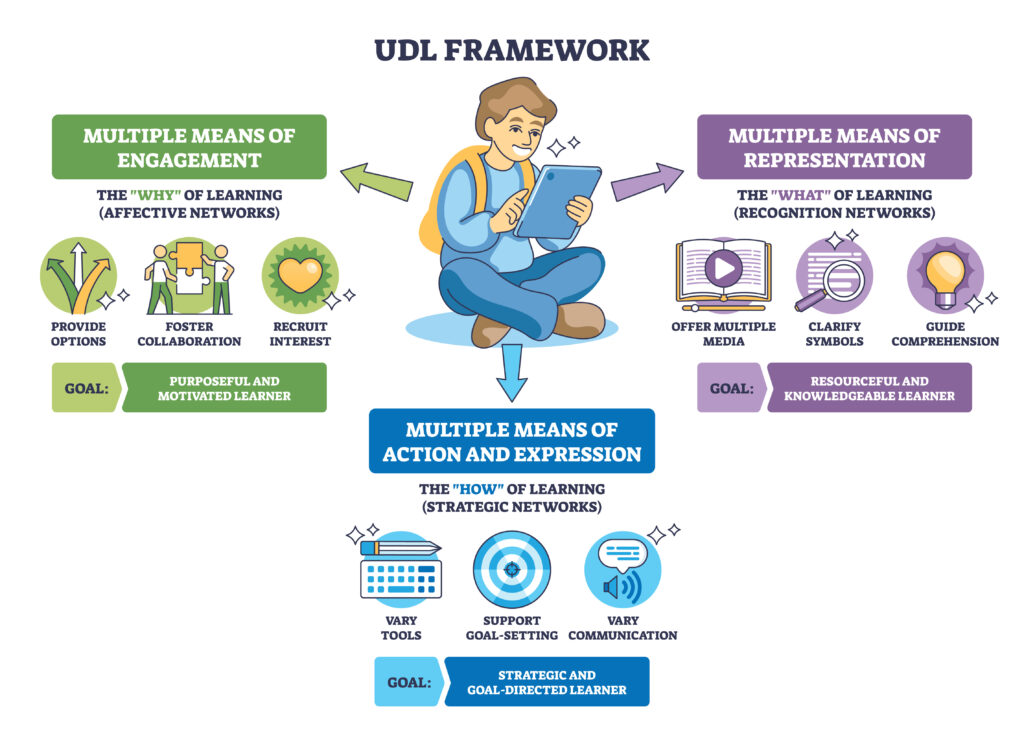
Here is what makes UDL 3.0 better than a compliance checklist. It works across all three dimensions of your course design:
- Principle I — Multiple Means of Engagement (the WHY and WHO of learning) asks you to design for student identity, emotion, and motivation from the start, focusing on early-semester course decisions that enhance belonging, clarity, and cognitive access.
- Principle II — Multiple Means of Representation (the WHAT of learning) is where most WCAG compliance lives: present content in multiple formats (text, visuals, audio, guided notes, captions, etc.) and you are building accessibility in, not bolting it on.
- Principle III — Multiple Means of Action and Expression (the HOW of learning) asks you to give students more than one way to demonstrate what they know, which reduces your dependence on any single tool that may itself be inaccessible.
A course designed with UDL 3.0 principles not only meets compliance standards but also significantly decreases the number of individual accommodation requests you might receive during the semester. More importantly, implementing UDL 3.0 creates an inclusive learning environment that enhances educational experience for all students. This approach benefits every learner, including those who may not actively seek accommodation but still face challenges with content delivery, engagement, and assessment. With thoughtful designs, UDL 3.0 fosters better learning outcomes for all.
Three things you can do this summer
- Caption your video. If you have recorded lectures posted without captions, start with your most-watched one. Most LMS platforms and YouTube offer auto-captioning—review and correct it. One video is a real start.
- Run your most-used documents, PDF, Word, or PPT, through an accessibility checker. Adobe Acrobat, Microsoft Word and PPT, and free tools like PAC 2026 can flag the most common issues — missing headings, untagged images, poor reading order.
- Offer one alternative assessment format. Look at your next assignment. Ask: Is there a reason it must be a written essay, or could a student demonstrate the same learning through a recorded explanation, a structured outline, or an annotated bibliography? Having options is not lowering the bar. It’s UDL Principle III in action.
Regardless of the deadlines and extended deadlines, accessibility is long overdue. The good news is that good teaching and legal compliance point in the same direction. UDL 3.0 can be your roadmap.
References:
- Atkinson, R. K. (2002). Optimizing learning from examples using animated pedagogical agents. Journal of Educational Psychology, 94(2), 416-427. https://doi.org/10.1037/0022-0663.94.2.416
- Barnes, A. J., & Shavitt, S. (2023). In what ways do accessible attitudes ease decision making? Examining the reproducibility of accessibility effects across cultural contexts. Journal of Personality and Social Psychology, 126(6), 1036–1051. https://doi.org/10.1037/pspa0000363
- Brunken, R., Plass, J. L., & Leutner, D. (2004). Assessment of cognitive load in multimedia learning with dual-task methodology: Auditory load and modality effects. Instructional Science, 32(1), 115-132. https://www.jstor.org/stable/41953640
- Caldwell, B., Cooper, M., Guarino Reid, L. & Vanderheiden, G. (2008). Guideline 1.1 Text alternatives: Provide text alternatives for any non-text content so that it can be changed into other forms people need, such as large print, braille, speech, symbols or simpler language. Web Content Accessibility Guidelines (WCAG) 2.0. https://www.w3.org/TR/WCAG20/#text-equiv:~:text=Guideline%201%2E1,language
- Cartwright, K. B., Barber, A. T., Zumbrunn, S. K., & Duke, N. K. (2023). Self-regulation and executive function in language arts learning. In D. Lapp & D. Fisher (Eds.), Handbook of research on teaching the English language arts (pp. 312-332). Routledge.
- Chen, J., Zhou, X., Wu, X., Gao, Z., & Ye, S. (2023). Effects of exergaming on executive functions of children: a systematic review and meta-analysis from 2010 to 2023. Archives of Public Health, 81(1), 182. https://doi.org/10.1186/s13690-023-01195-z
- Cruz, B., Meca, A., Wright, A., Veniegas, T. K., Allison, K. K., Santibanez, L., Scurry, S. & Gonzales-Backen, M. (2024). Examining the role of identity development and cultural stressors in the establishment of a US identity among Hispanic/Latinx college students. Journal of Latinx Psychology, 12(3), 245–260. https://doi.org/10.1037/lat0000252
- Grenell, A., & Carlson, S. M. (2021). Individual differences in executive function and learning: The role of knowledge type and conflict with prior knowledge. Journal of Experimental Child Psychology, 206, 105079. https://doi.org/10.1016/j.jecp.2020.105079
- Hinnant-Crawford, B., Bergeron, L., Virtue, E., Cromartie, S., & Harrington, S. (2023). Good teaching, warm and demanding classrooms, and critically conscious students: Measuring student perceptions of asset-based equity pedagogy in the classroom. Equity & Excellence in Education, 56(3), 306-322. https://doi.org/10.1080/10665684.2023.2166446
- U.S. Department of Justice. (2026, April 20). Extension of compliance dates for nondiscrimination on the basis of disability; accessibility of web information and services of state and local government entities. Federal Register. https://www.federalregister.gov/documents/2026/04/20/2026-07663/extension-of-compliance-dates-for-nondiscrimination-on-the-basis-of-disability-accessibility-of-web
