

The following snapshot of online learning at NIU offers a glimpse into the current state of online learning and highlights a few of the current online learning trends compiled by the Center for Innovative Teaching and Learning (CITL) as of Fall 2024.
Student Preferences for Online Courses
Online Course Enrollment
As we consider student preferences for taking online courses and compare pre-pandemic vs. current enrollment and student credit hours in online courses, it’s clear that student demand for online courses remains strong. Looking at student enrollment in online courses, in Fall 2019 (pre-pandemic), 32% of NIU undergraduate students and 14% of NIU graduate students took at least one online course. In Fall 2024, 62% of NIU undergraduate students (7,040) and 19% of NIU graduate students (704) took at least one online course. That’s roughly 6 in 10 undergraduate students and 1 in 5 graduate students taking at least one online course in Fall 2024.

Program Format Preference
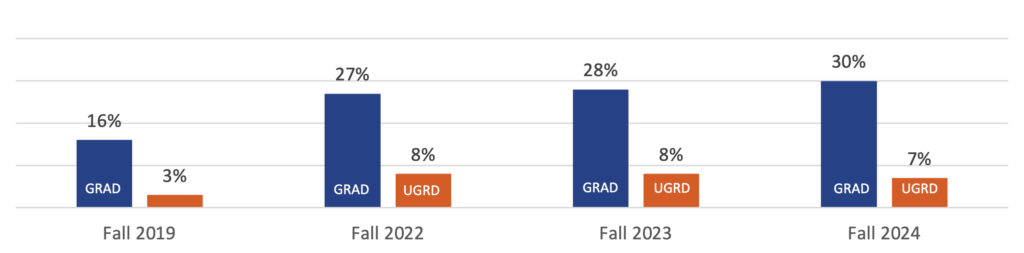
NIU students still predominantly prefer in-person and hybrid programs to fully-online programs. In Fall 2024, only 7% of undergraduate students (817) and 30% of graduate students (1,113) graduate students took only online courses. This is up from 3% of undergraduate students (414) and 16% of graduate students (666) pre-pandemic in Fall 2019.
Online Student Credit Hours
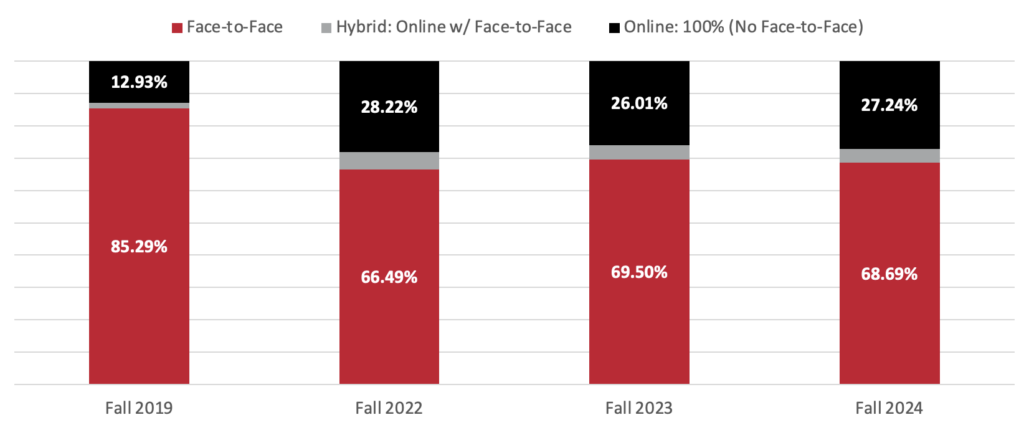
Similarly when looking at student credit hours (SCH) by mode of instruction, we see a similar trend for students completing a higher percentage of credit hours through online courses as compared to pre-pandemic years. In Fall 2019 (pre-pandemic), 12.9% of all SCH were from online courses. In Fall 2024, 27.24% of SCH were from online courses and 4.1% were from hybrid courses.
Faculty Teaching Online Courses
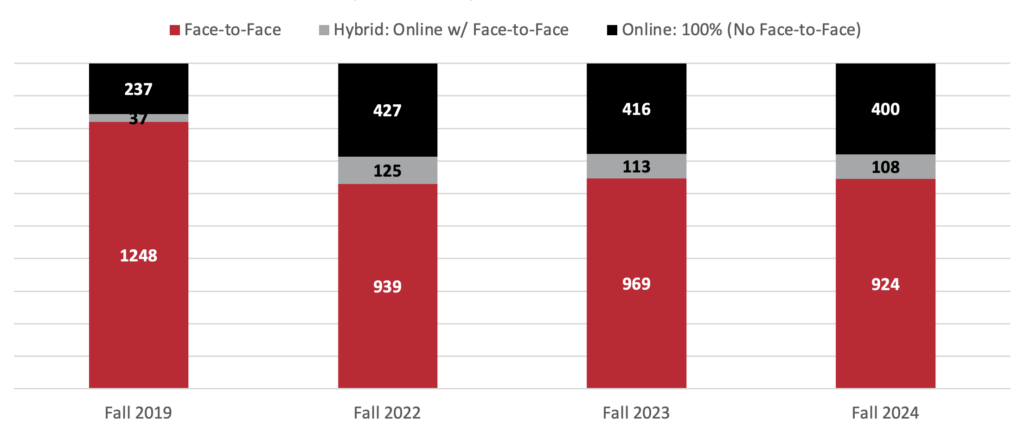
As expected when looking at faculty teaching online courses and comparing pre-pandemic offerings of online courses to current, we see a continued significant increase in the number of NIU faculty who are teaching online and hybrid courses. In Fall 2019 (pre-pandemic), 35 faculty taught hybrid courses and 237 faculty taught online courses, as compared to Fall 2023, in which 113 faculty taught hybrid courses and 416 faculty taught online courses.
Of all 1,151 faculty (including all categories of faculty and teaching staff) who taught courses during Fall 2024, 34.7% (400) taught at least one online course and 9.3% (108) taught at least one hybrid course.
Professional Development and Support for Online Teaching
Faculty who teach online courses continue to utilize available online teaching support at NIU. In reviewing faculty participation in professional development and support for online teaching, of the 400 faculty who taught at least one online course and the 108 faculty who taught at least one hybrid course during Fall 2024, 71.0% have received some type of individualized support for their online teaching, 51.4% have attended faculty online teaching workshop(s), and 24.4% have completed the Online Course Design Academy during the past five years.

Recognition of Excellence in Online Teaching
Quality Essentials Course Review
With the launch in Fall 2022 of Quality Essentials Course Review for online courses, CITL provides faculty with additional feedback, course development partnership support, and recognition for courses that meet Quality Essentials Design Standards. We’ve thus far recognized 23 courses and look forward to that number steadily growing in the coming year. We encourage faculty to use the new Quality Essentials Review Tool to conduct a self-review of their courses and then submit for additional review and feedback by a CITL staff member.
Excellence in Online Teaching Award
The Excellence in Online Teaching Award (EOTA), established in 2021, encourages and honors outstanding online and hybrid teaching at NIU. It recognizes NIU faculty whose performance exemplifies a commitment to excellence in online teaching, course development, and student engagement. Two faculty were recognized with this award in 2024, including:
- Therese Arado, College of Law
- Susan Bowers, Family and Consumer Sciencews
Nominations for the 2025 Excellence in Online Teaching Awards are due January 31st. Find more nomination details.
