
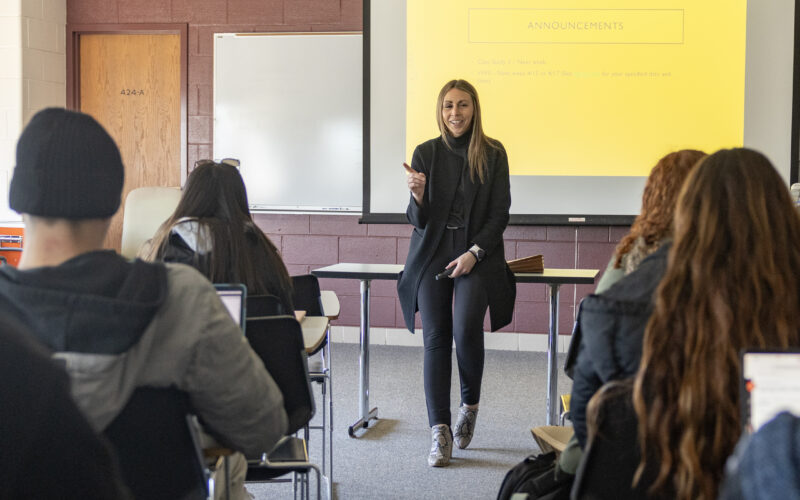
I recall walking into a lecture hall and disappearing into the crowd in many of my undergraduate courses. Like any hopeful and determined first-generation student, I must succeed in this class to be closer to a degree that ultimately leads to a well-paid job. So, I did my best to stay awake and take notes during the lecture despite being exhausted after a long day at work. Most of the time, I fell asleep, learned nothing, and was grateful the professors didn’t notice or call me out so I could sleep. (Thank you!)
Fast forward to 2026: we’re in a booming content creator economy where students, accustomed to engaging with social media, demand “better” classroom experiences. To capture their attention and encourage participation—especially from quieter students—we must be more intentional about our teaching practices. Research shows that actively involving students enhances learning in diverse classrooms (Milem, 1998), but achieving equitable engagement requires deliberate strategies. When done right, active learning can be more captivating than TikTok videos.
Meaningful participation is rooted in community. When students feel safe, valued, and capable, they engage more with peers and instructors, take intellectual risks, and participate actively in discussions. So, how can we foster this community in our classrooms?
It starts with you – be authentic
 Share your own story with students. Why did you choose your field? What challenges did you overcome? What are you excited about teaching in this class?
At NIU, where more than half of our students are the first in their families to attend college, I shared my personal story as a first-generation college graduate. I talked about how education changed my life and helped me break the cycle of poverty in my family. It helped students see me as a real person invested in their success. This authenticity invites students into a genuine learning partnership.
Help students connect with each other – small acts, big impacts
Even in large lecture halls, you can build community by having students introduce themselves and exchange contact information, which helps combat isolation, especially for first-generation students. Use pre-class surveys on platforms like Blackboard to encourage introductions and share interests. Icebreaker activities are also effective for connecting students.
Establish clear structures and routines
Predictability reduces anxiety for quieter or neurodivergent students who may hesitate to speak when unsure of expectations. Break your course into consistent weekly modules with regular patterns—readings, formative assessments with unlimited attempts, practice tests, and scheduled exams. When students know what to expect and when, they can focus their energy on learning rather than navigating uncertainty.
Communicate clearly and intentionally
Clear communication guidelines can save time and reduce frustration for the almost-silent multilingual learners. Include your policies in the syllabus, use Blackboard announcements for upcoming assignments, and establish clear expectations for email response times. In large courses, like mine, ask students to include their course and section numbers in the subject lines of their emails. These practices help instructors save time and enhance student engagement.
Co-create participation norms with students
Classroom norms influence student interactions, and it’s best to involve students in establishing these guidelines to make enforcement easier.
Setting clear expectations about punctuality, technology use, and side conversations on the first day is crucial. In laboratory courses with safety concerns, consider having them sign a code of conduct to confirm understanding of lab protocols. In discussion-based classes, encourage awareness of participation habits and encourage dominant voices to listen more. Recognize how factors like gender, cultural background, and life experiences shape participation. Promote good-faith intention while addressing negative impacts as they arise.
Call on students equitably
Managing who speaks when is critical for academic equity and excellence. We can’t let the loudest fast talkers’ voices dominate while the quieter, deeper thinkers’ perspectives go unheard.
Use cold calling strategically
In large classes, cold calling encourages participation from less vocal students. Warn students at the start of the semester so everyone stays prepared and engaged. Be ready for awkward silence—it’s part of the process. Assuming, by this time, you have cultivated a safe and brave, supportive learning community where mistakes are an effective way to learn, cold calls can be fun and interactive.
Extend wait time
 After posing a question, wait a full minute before calling on anyone. This simple strategy increases thinking time and allows more shy students to find the courage to speak up. Set a visible timer if the silence feels uncomfortable. An extended wait time provides critical neural processing time for all students.
Scaffold wait time with write time
Wait time alone may not be enough for some students. Have students write one or two initial thoughts before answering the question posed. This writing helps students reflect on their learning, identify points of confusion, and discover key insights. The practice of writing, if collected, can hold students accountable for their thinking and for recording their ideas.
Implement think-pair-share
This technique is one of my favorite active learning practices. It works well in almost all situations but is especially helpful for a large-enrollment class. It cultivates equity by providing multiple means of participation, allowing students time to express their thoughts individually, then discussing ideas with peers, and transforming the classroom into a more participatory space for collaborative learning. When we start small by having students discuss in pairs or small groups before sharing with the whole class, it helps the quieter students gain confidence to speak.
Assess participation accurately
If you grade participation, beware of potential biases. Some students struggle with eye contact, speaking up, or note-taking for legitimate reasons unrelated to engagement or learning.
Align assessments with learning objectives
Grade whether students acquire course objectives, not their confidence, compliance, or personality. Be intentional about why and how you want to grade participation and be transparent with students about how participation helps them acquire the knowledge and skills required in this class and for their future careers.
Consider alternatives to traditional grading
Can participation be a formative assessment? Part of a final paper or presentation? Could you use expansive feedback strategies instead of a grade? Develop and provide students with clear rubrics for grading participation if you do grade.
Talk to disengaged students individually
Given shifting power dynamics between instructors and students, the fear of point deduction has lost effectiveness. Penalizing disengagement often does not lead to more participation; try talking to students outside class to understand what prevents them from participating. This compassionate approach often yields better results.
Transform your classroom today
 Creating equitable participation doesn’t rely on flashy content or mirroring content creators’ tactics—it comes from intentional, research‑informed teaching that makes every student feel heard, supported, and capable. By building community from the very first class, co‑creating clear participation norms, and using thoughtful strategies like extended wait time, scaffolded write time, and structured peer interaction, we can open the door for quieter voices to contribute meaningfully. When we provide varied participation opportunities that align with students’ strengths and design assessments that reflect learning rather than confidence or personality, we encourage all students to engage. These shifts don’t require more time or resources—just purposeful choices that prioritize belonging and access.
As you refine your teaching this semester, choose one strategy to try, observe its impact, and build from there. Small, intentional changes can transform not just students’ participation, but the entire teaching and learning experience.
Learn more
- Cooper, K. M., & Brownell, S. E. (2016). Coming Out in Class: Challenges and Benefits of Active Learning in a Biology Classroom for LGBTQIA Students. CBE life sciences education, 15(3), ar37. https://doi.org/10.1187/cbe.16-01-0074
- Dallimore, E. J., Hertenstein, J. H., & Platt, M. B. (2006). Nonvoluntary class participation in graduate discussion courses: Effects of grading and cold calling. Journal of Management Education, 30(2), 354-377. https://doi.org/10.1177/1052562905277031
- Milem, J. F. (1998). The educational benefits of diversity: Evidence from multiple sectors. In G. Orfield and M. Kurlaender (Eds.), Diversity Challenged: Evidence on the Impact of Affirmative Action (pp. 107-130). Harvard Education Publishing Group.
- Moffett, J., Berezowski, J., Spencer, D., & Lanning, S. (2014). An investigation into the factors that encourage learner participation in a large group medical classroom. Advances in Medical Education and Practice, 5, 65-71. https://doi.org/10.2147/AMEP.S55323
- Northern Illinois University Center for Innovative Teaching and Learning. (2012). The process of grading. In Instructional guide for university faculty and teaching assistants. Retrieved from https://www.niu.edu/citl/resources/guides/instructional-guide
- Pollock, P., Hamann, K., & Wilson, B. (2011). Learning Through Discussions: Comparing the Benefits of Small-Group and Large-Class Settings. Journal of Political Science Education, 7(1), 48–64. https://doi.org/10.1080/15512169.2011.539913
- Schinske, J. N. (2011). Taming the Testing/Grading Cycle in Lecture Classes Centered Around Open-Ended Assessment. Journal of College Science Teaching, 40(4), 46–52. http://www.jstor.org/stable/42992877
- Tobin, K. (1987). The role of wait time in higher cognitive level learning. Review of Educational Research, 57(1), 69–95. https://doi.org/10.2307/1170357
